


The ability of natural systems to alter function in direct response to environmental conditions has inspired many scientists to fabricate ‘smart’ materials that respond to temperature, light, pH, electro/magnetic field, mechanical stress and/or chemical stimuli. These responses are usually manifested as remarkable changes from the molecular (e.g., conformational state, hierarchical order) to the macroscopic level (e.g. shape, surface properties). Among many types of stimuli responsive materials, self-assembled viscoelastic gels of both organic solvents (organogels) and water (hydrogels) have been recognized as promising materials for bottom-up nanofabrication tools in various fields such as biomedicine, catalysis, adaptive membranes, non-invasive sensors, cosmetics, foods and environmental remediation. In contrast to chemical gels, which are based on covalent bonds (usually cross-linked polymers unable to redissolve), physical (also called supramolecular) gels are made of either low-molecular-weight compounds or polymers (gelators) through extensive non-covalent interactions. Many gels have been found by serendipity rather than rational design, but we are also convinced that serendipity often provides a major opportunity for scientific discovery. The formation of supramolecular gels is a result of a well-balanced combination of numerous non-covalent interactions, including those between gelator-gelator, gelator-solvent, aggregate-solvent and solvent-solvent molecules. Usually, a lack of control over these interactions caused an unpredictable competition between crystallization and gelation phenomena. We are learning about the key factors that govern the equilibrium position and how can we favor one of the two processes selectively in order to access to a wider range of materials with different properties from the same building blocks. For example, we have been able to synthesize either metal-organic-frameworks (MOFs) or metal-organic-gels (MOGs) by small changes in the solvent composition using the same ligand and metal precursors. In the broad field of polymer gels, we are also involved in the rational design of polymer gelators, including charged systems (e.g., polyelectrolytes), with enhanced gelation efficiency and new functionalities, for which we employ molecular dynamic simulation tools. These systems constitute promising materials for soft-robotic actuators, supercapacitors, drug vehicles, gene transfection, contaminant removal, etc.
Research
I. STIMULI-RESPONSIVE, NANOSTRUCTURED AND MULTIFUNCTIONAL SOFT MATERIALS
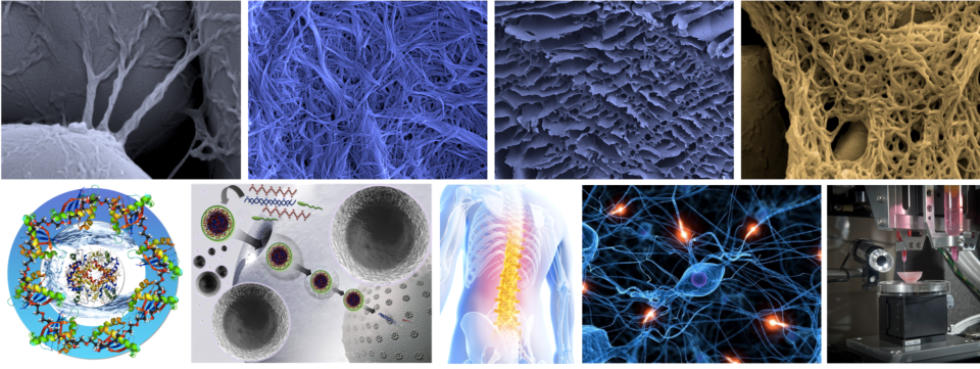
We are interested in the development, modification, and applications of new multiresponsive and/or reactive gels, including catalytic and self-healing metal-organic gels, as well as in the study of supramolecular chiral amplification with these materials, which may have important implications related to the origin of life and evolution. In general, we try to find the most simple and reliable synthetic approaches for creating new and complex functions. We focus on the design, synthesis, characterization, mechanistic studies, and use of gels for biomedical applications (including controlled release of (bio)active molecules, targeted gene delivery, cancer treatment, bioimaging, scaffolds for tissue engineering, actuators, nerve regeneration, treatment of spinal cord and brain damages, etc.), optical and forensic applications, art conservation/restoration, environmental remediation, catalysis, fabrication of conductive nanowires, wearable sensors, selective membranes, protective surface coatings, nanocomposites, and nanoreactors, among other real-life applications in the broad field of nanotechnology. A number of advanced processing tools, technologies, materials and synthetic strategies play a key role in the development of this key program in our group. This includes the use of 3D printing, energy upconversion, isosteric replacement, dynamic bonding, topological polymer chemistry, simulators of harsh-conditions, organic-inorganic hybrids, dielectric materials, shape-memory systems, etc.
II. BIOINSPIRED REACTIVITY IN CONFINED MEDIA AND NANOMATERIALS
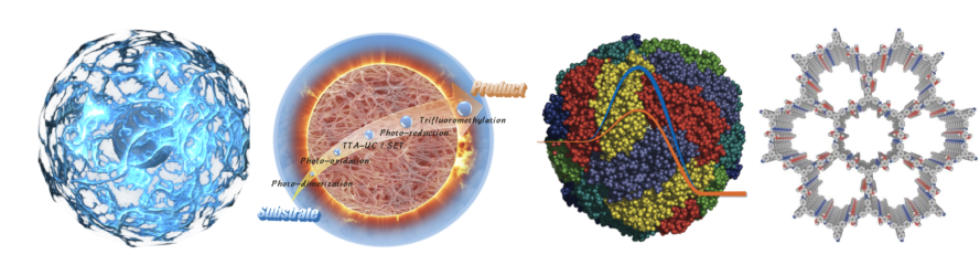
Inspired by nature, much effort has been devoted over the last decade to the study of meso-, micro- and nano-scale reactors. The main reason for this is the fact that many chemical reactions take place with high efficiency in natural confined and compartmentalized environments defined my numerous interfaces where the motions of reactant molecules are restricted compared to that in free solution. In concordance, numerous advantages have been also attributed to the use of synthetic nanoreactors including, among others, the possibility of tailoring additional functionalities, organization and orientation of solvent, catalyst and reactant molecules, controllable molecular diffusion, large surface area to volume ratios and reduction of overheating/concentration effects. In our group we wish to understand the changes on kinetics and chemical pathways/selectivities of different types of reactions, with great emphasis on photochemical transformations for the preparation of light-harvesting systems. These reactions are frequently promoted by laser or LED technology, being carried out within nanostructured and stimuli-responsive soft materials, which can be tuned for working as reaction vessels, biocompatible nano/microreactors and/or reusable catalysts. One of the main advantages of using, for instance, softgel networks as reaction media is the possibility to perform highly air-sensitive photochemical reactions under aerobic conditions. Beyond kinetics and selectivity aspects in comparison to solution phase, this project aims to contribute in building a challenge bridge between solution and biocompatible supramolecular responsive formulations for the selective activation and control release of bioactive compounds for the treatment of different diseases. Within this context, we work with gels, niosomes, liposomes, dendrimers, vesicles, emulsions, as well as different types of molecular systems, nanoparticles and polymers -including natural polymers and proteins- to develop such formulations. Furthermore, we believe that studying the intrinsic role of proteins in mediating bond formation/cleavage will be also crucial for understanding mechanism in evolution and designing «greener» catalysts. Within the overall program, we also contribute on the preparation of highly stable metal and covalent organic framework-based materials (e.g., MOFs, COFs) with superior properties for applications in gas adsorption, catalysis, environmental remediation, energy storage (e.g., water oxidation, hydrogen evolution), and biomedical applications (e.g., targeted anti-cancer drug delivery, diagnostic imaging). Moreover, we are interested in the development of new physical and chemical strategies to stabilize unstable nanoparticles, and on the use of functional nanoparticles to stabilize other structured materials.
III. SUSTAINABLE (BIO)ADHESIVE AND SEALANTS POLYMERIC MATERIALS
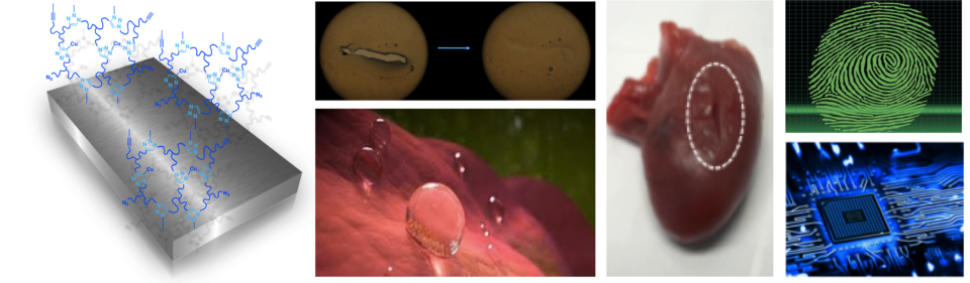
Polymer chemistry has been a rich beneficiary of the ability of click reactions to make molecular connections with absolute fidelity. Polymer synthesis depends on a limited number of processes that include many of the best examples of click reactivity. During the last decade we have been working in the development of new bulk polymers with adhesive properties for metal surfaces making use of the copper-catalyzed azide-alkyne cycloaddition (CuAAC). In this field, not only CuAAC, but also its copper free-version (i.e. strain-promoted azide-alkyne cycloaddition (SPAAC)) constitute a versatile tool for the fabrication of nanocomposites with tuneable properties such as conductivity, mechanical strength, and morphology, especially for biomedical and membrane applications. Some of our materials have been found to possess superior adhesive strength than standard commercial glues. We continue working on the improvement of these formulations as well as on the application of this technology in areas such as conductive materials, antifouling coatings, sensors, under-water adhesion, mucoadhesives, or superhydrophobic surfaces. We are also interested in exploring the use of dynamic covalent chemistry (DCC) for the synthesis of self-healing, stretchable and adhesive polymers. Moreover, with the growing concern for our environment and stringent environmental regulations by the governments, emphasis of science and technology is shifting more and more from petrochemical-based feedstocks towards the optimal use of environmentally friendly and sustainable resources and processes. In this regard, direct utilization of products derived from naturally occurring materials has become a prevalent means for a number of high-tech applications. Thus, we are also interested in development of eco-friendly adhesive formulations derived from natural resources, which can be also integrated within circular economy dealing with biomass revalorization.